Rustic Retreat
Hot Projects
Live broadcasts and documentation from a remote tech outpost in rustic Portugal. Sharing off-grid life, the necessary research & development and the pursuit of life, without centralized infrastructure.

Subscribe to our new main project Rustic Retreat on the projects own website.
Apollo-NG is a mobile, self-sustainable, independent and highly-experimental Hackbase, focused on research, development and usage of next-generation open technology while visiting places without a resident, local Hackerspace and offering other Hackers the opportunity to work together on exciting projects and to share fun, food, tools & resources, knowledge, experience and inspiration.
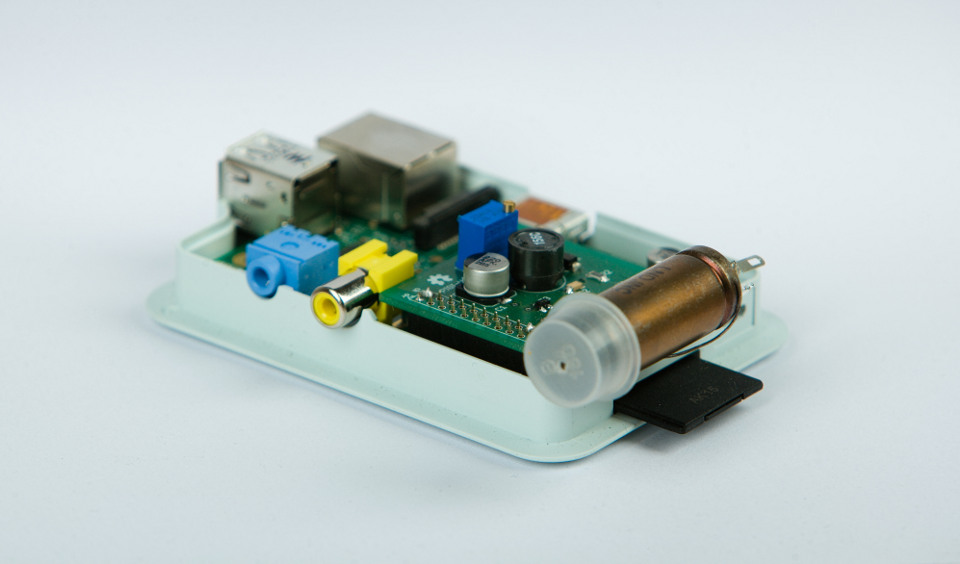
Continuing on the final aspect of JamesT's very nice exploration of PiGI, we want to further examine the possibilities to create randomness from the output of a Geiger-counter. Of course we are using a PiGI as testbed for our experiments.
True randomness, in the sense of “provably unpredictable” is not easily available on a computer. Good arguments can be made that the available sources of entropy like clock jitter, floating analog inputs, network traffic etc, combined with the algorithmic magic of /dev/random and /dev/urandom are more than adequate for all non-cryptographic purposes, and probably unpredictable enough to safely use them in cryptography without worrying to much.
But paranoia and cryptography run hand in hand and using radioactive decay as source of entropy is an interesting application of physics to provide access to the elusive “true” randomness on a computer.
While the half-life gives the duration after which a particle has decayed with a probability of 50%, the exact moment of decay can not be predicted in any way. So a sample of radioactive material creates a stream of events in a Geiger-counter, which, due to the enormous amounts of atoms even in the tiniest sample, averages to a steady rate, but the specific event times (or delays between events) are unpredictable.
In the most fundamental form, our task is to produce a stream of equally probable 0's and 1's. To do this, we compare the last two delays between measured events. If one is longer than the other, the next bit is a 0 and if it is shorter it is a 1.
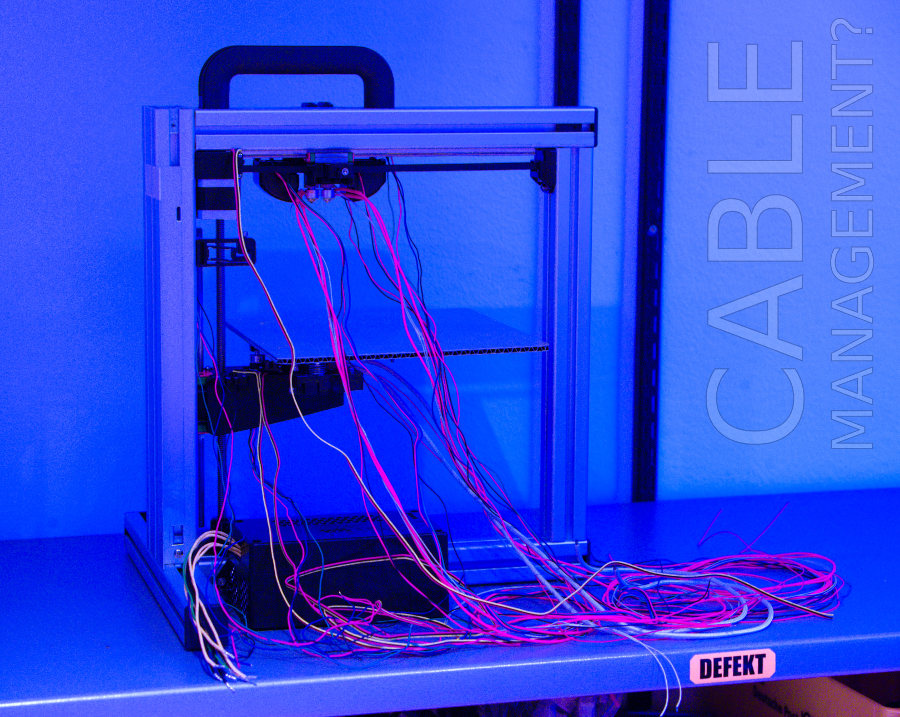
At long last the Felix 3.0B upgrade parts have finally arrived last week and the picoprint underwent a complete overhaul. On Friday night the printer was completely disassembled, except for the bare frame.
All printed plastic parts (V2.0) were packed away (as a backup for now) and all screws, nuts and other metallic parts took a bath in WD-40 for 24 hours and were cleaned, re-sorted and stored in the original container. Having only sunday left, the assembly of the 3.0B went up to the part of implementing proper cable management.
This shot gives a good impression of the amount of cables to route and this is only the bare Felix configuration without any other extras. The next long weekend is directly ahead, so the printer should be fully upgraded, re-pimped and ready to print on the weekend.
About time, I miss the smell of extruded PLA in the morning…
I've seen this “exxploit” truck in the center of Munich a couple of times from the bus but today it was standing right in front of me so I could take a picture and share it because I really like the message: